
Legal work, on demand.
Type the request. Review, draft, redline, summarise, restructure. Lavern's team picks up the work. The instruct line is the front door.

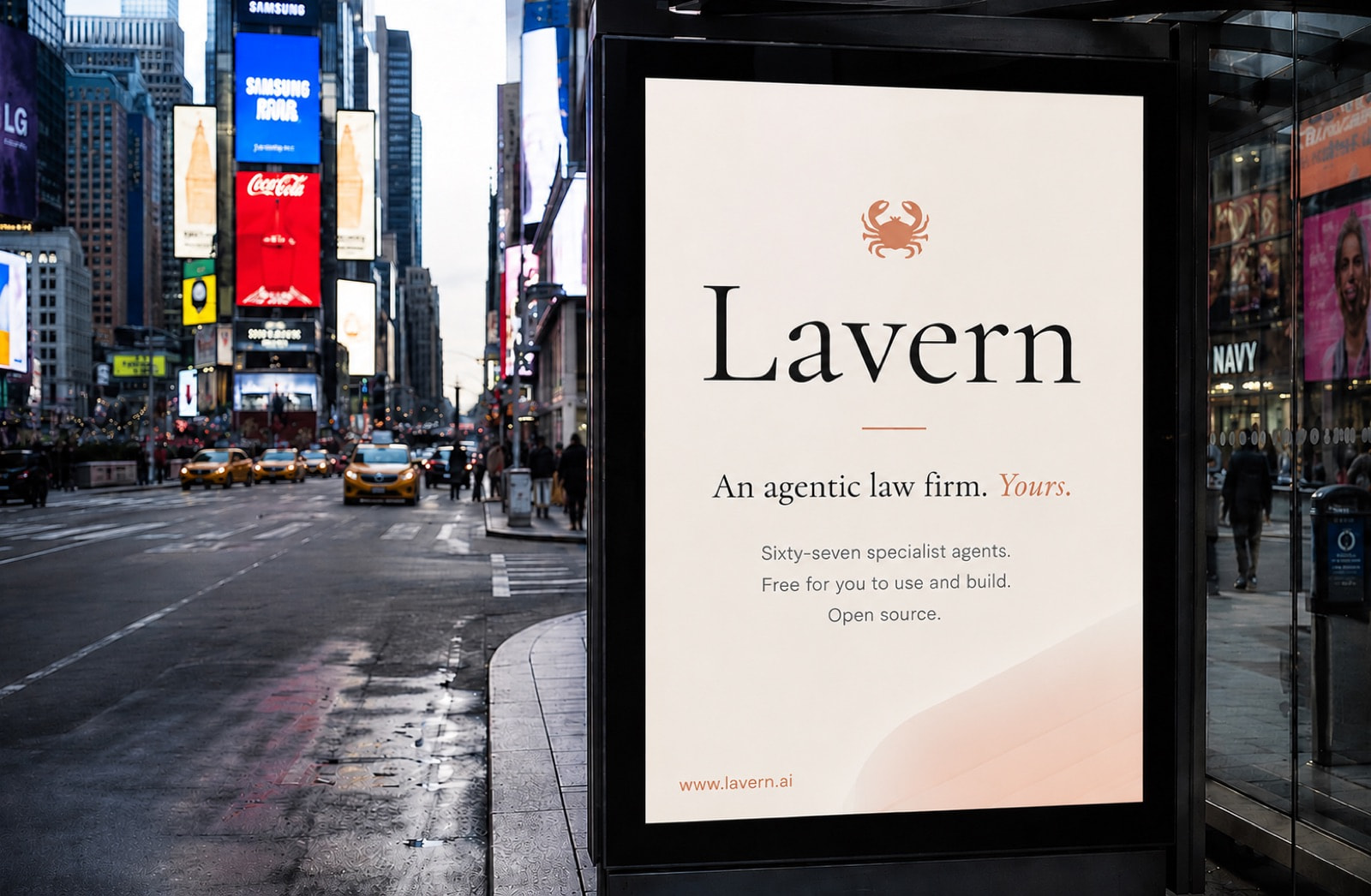
Sixty-seven specialist agents.
Free for you to use and build.
Open source.
Built by a law firm founder.
Use at your own risk. Not legal advice. Not a real law firm.
Lavern on your desk · Not in a browser tab
“This is one of the most unique legal tech projects I have ever seen.” — General Counsel
Type the request. Review, draft, redline, summarise, restructure. Lavern's team picks up the work. The instruct line is the front door.
Sixty-seven specialists with skill ratings, personalities, and faces. M&A partner, adversarial associate, jurisdictional specialist. Or build your own.
Every finding cites evidence. Every challenge cites counter-evidence. The orchestrator weighs both and resolves. The audit trail is a side effect.
Write the principles. They flow into the orchestrator's system prompt for every engagement. The firm sounds like the firm. Not like a model.
Five public legal datasets out of the box. Plus your firm's precedents, contracts, memos, anything. Drop a folder, it indexes, the agents cite it.
A loop that checks, critiques, and iterates produces a deliverable. A single pass produces a draft. Lavern is a loop. That's the difference.
Twelve states. Buy-side. Three risks ranked by severity.
Lavern produces real documents. Executive memos, redlines, board emails. Typeset, cited, ready to send. Not a chat transcript. A deliverable.
An adaptive interview builds the context every agent will need. Jurisdiction, deal size, risk appetite, intent. The model is not the bottleneck. Context is.
Ask questions, interrupt the work, reopen the conversation post-delivery. Voice in three places. The partner you're talking to is the one you picked.
Point Clawern at a folder. It watches, drafts findings, delivers a bundle. Runs on your machine with local models. No document leaves the laptop.
Not a product. A suite of ideas you point your AI at. Watch it make better.
Architecture borrowed from law firms as an analogy. Partners, associates, debate rooms, institutional memory. Sixty-seven specialist agents organised the way a firm would organise itself, in software. Lavern itself is not a law firm.
src/agents/ · 67 specialistsEvery challenge cites counter-text. The orchestrator weighs both and resolves. The audit trail isn't bolted on after. It's a side effect of how the system thinks.
src/mcp/tools/ · 21 modulesBriefing loops. Debate loops. A ten-pass verification loop before anything reaches the user. Workflows aren't chains. They're spirals that tighten until the work survives.
src/workflows/ · 1,700+ testsThe model is not. An intake that asks questions outperforms one that doesn't. Lavern interviews before it acts. The briefing alone is most of the work.
src/api/briefing.ts · LLM-led intakeRuns on Anthropic or Mistral for EU data sovereignty. Optional on-device mode means confidential documents never leave your machine. The system follows your jurisdiction.
src/providers/ · Claude · Mistral · OllamaPointed at a folder, Lavern becomes Clawern. Runs on a thirty-minute heartbeat with precedent memory, cost forecasting, and a hard budget cap. It watches. You decide.
src/claw/ · 28 modules · LaunchAgentEvery agent prompt, debate protocol, precedent rule, and verification pass is there to be read, audited, and argued with. Apache 2.0 licensed. Made in Helsinki.
github.com/AnttiHero/lavern · Apache 2.0Senior partners, associates, jurisdictional specialists, dark-pattern auditors. All ready to engage on a single document.
Passes through the quality loop before a document reaches the user. One pass produces a draft. Ten produce a deliverable.
Automated tests across the codebase. Unit, integration, security, fuzz. Open source. Read them. Argue with them.
Helsinki built. The world reads.
No. Lavern assists with document design, review, and accessibility. It does not constitute legal advice and does not replace a qualified lawyer. Lavern is also not a real law firm. It is an analogy we used for building it.
There are many definitions of an agent. The agents in Lavern are real agents in the sense that they debate each other, challenge findings, and verify claims. On the other hand, they may not be agents in the sense of carrying out complex tasks fully independently. The value is in orchestrating LLMs, not in heroically autonomous workflows.
No, not in a traditional sense. You could build a product on top of this, and we would be delighted if you did. But it is best understood as a working demo. We tried to make it as safe as we could, and you should understand that you are using it at your own risk.
A single LLM call is one agent guessing. Lavern is a system of agents with evidence requirements, debate, a soul, a knowledge base, and a ten-pass verification loop. Quality lives in the loops. Not in any single inference. The model is interchangeable. The architecture is not.
Lavern communicates with frontier models such as Claude and Mistral. Local mode runs on-device. Hybrid mode runs a local pass first and then dispatches only flagged questions to a frontier model. As with all legal work, you have to be conscious of client privilege and privacy.
The software is free and Apache 2.0 licensed. Running it costs whatever your LLM provider charges. Typically a few cents to a few dollars per engagement, depending on team size and document length. Local mode is $0. Clawern includes per-document cost forecasting and a hard budget cap.
Making language models truly argue is still an open problem. They're sycophantic by default. We've built structures around it: evidence weight requirements, confidence thresholds, adversarial roles, escalation protocols. It works better than no structure. It's not solved. We are still learning, like everybody else.
Yes. The CLI runs anywhere Node 22+ runs. Frontier mode needs API keys (Anthropic or Mistral). Local mode needs Ollama and a model like Llama 3 or Qwen 2.5. Clawern is a macOS LaunchAgent / Linux systemd daemon.
Apache 2.0. Fork it, ship it, sell what you build on top, attribute where appropriate. The agent prompts, the debate protocols, the verification pipeline, the precedent board. All of it. The Apache license includes an explicit patent grant — contributors can't sneak in patented code and then sue your users. Knowledge-base datasets carry their own licenses (CC BY 4.0, CC BY-SA 4.0). Non-commercial restrictions are flagged per-dataset.
Legal AI shouldn't be a black box. If a system is going to draft, redline, or critique a document with real-world consequences, the operator deserves to read the prompts, audit the loops, and replace the parts they disagree with. The source is available, the ideas are there to be improved on, and the analogy is there to be argued with. That is the point of publishing it.
Claude for Law is already here. We need to build different.
Architecture deep-dive ↗Oh, and the name means nothing. No famous actor.